Digital Transformation Kenya — How Technology Is Reshaping Every Business in 2026
From Nairobi supermarkets to Kisumu wholesalers and Mombasa hospitality businesses, Kenyan organisations of every size are embracing digital transformation to automate operations, improve customer experience, and unlock growth that manual systems simply cannot deliver.
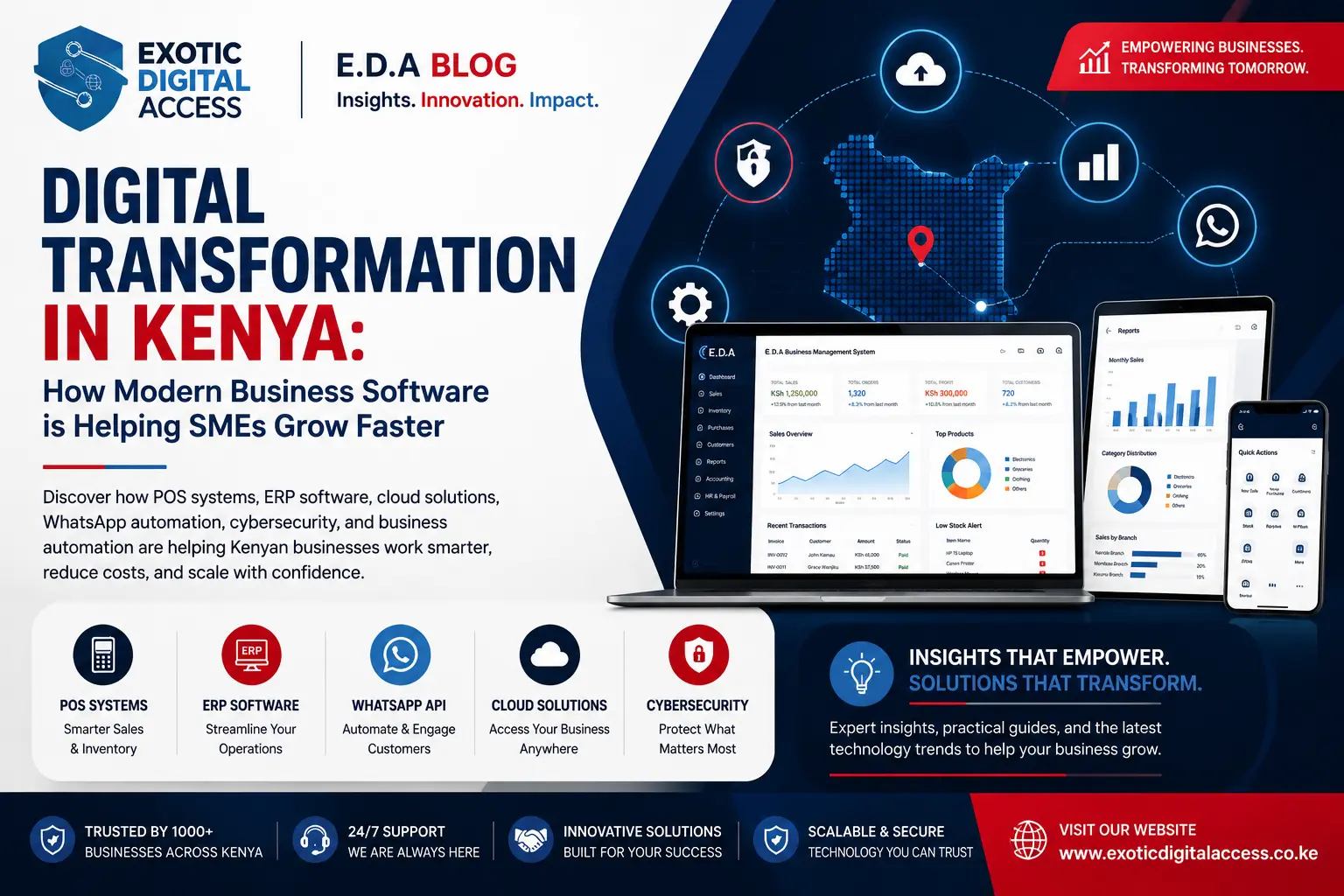
Technology is no longer reserved for large corporations. Across Kenya, businesses of every size — from single-counter retail shops in Murang’a to multi-branch distributors in Nairobi — are embracing digital transformation to improve efficiency, reduce costs, enhance customer experiences, and unlock sustainable growth. The question in 2026 is no longer whether to digitise. It is how fast, which technologies to prioritise, and which partner to trust with the transformation.
Digital transformation in Kenya is reshaping the entire business landscape. Manual processes that once defined daily operations are being replaced by intelligent systems that automate repetitive tasks, provide real-time visibility, and give business owners the data they need to make confident decisions at every level of the organisation. Whether it is a POS system in Kenya that automates payments and inventory simultaneously, ERP software that connects every department into one intelligent platform, cloud computing that gives business owners remote access to their operations from anywhere in the world, WhatsApp Business API that automates customer communication at scale, or cybersecurity solutions that protect the digital assets a business depends on — the direction is clear and the momentum is accelerating.
This guide covers the full landscape of digital transformation Kenya businesses need to understand in 2026: what it means, what is driving it, which technologies matter most, how different industries are transforming, and how Exotic Digital Access (E.D.A) is helping organisations across the country make the transition confidently and affordably.
In this guide
- What is digital transformation?
- Key drivers of digital transformation in Kenya
- The technologies reshaping Kenyan businesses
- POS systems — the entry point for most businesses
- ERP software — connecting the entire organisation
- Cloud computing — business from anywhere
- WhatsApp Business API — smarter customer communication
- Cybersecurity — protecting the digital business
- AI and automation — the next frontier
- How E.D.A helps businesses transform
- Digital transformation by industry
- Frequently asked questions
What Is Digital Transformation — and Why Does It Matter in Kenya?
Digital transformation is the process of using technology to fundamentally improve how a business operates, serves customers, and makes decisions. It is not simply about buying new software or moving records from paper to a spreadsheet. True digital transformation replaces disconnected, manual, and reactive processes with integrated digital platforms that give every part of the organisation the data and tools it needs to function more intelligently, more efficiently, and more responsively to what is actually happening in the business and in the market.
“Digital transformation in Kenya is not a technology initiative. It is a business survival initiative. The businesses that transform today are building operational advantages that compound in value for every year their competitors wait.”
— Exotic Digital Access, Kenya Technology Report 2026For a Kenyan SME, digital transformation typically looks like this: instead of a cashier manually writing receipts, counting stock by hand, and reconciling M-Pesa payments at the end of the day — the business uses a POS system that processes every sale automatically, deducts stock in real time, confirms M-Pesa payments instantly, generates KRA-compliant eTIMS invoices without any manual input, and updates the business owner’s analytics dashboard with live performance data they can access from their phone at any moment.
Multiply that single improvement across every operational function — payments, inventory, customer communication, payroll, reporting, compliance — and you begin to see why digital transformation is one of the most powerful competitive advantages a business in Kenya can build in 2026.
Further reading: Kenya’s Digital Economy Blueprint
The Kenya Ministry of ICT’s Digital Economy Blueprint outlines the government’s framework for accelerating digital transformation across the private and public sectors through 2030. Read the Digital Economy Blueprint →
For Kenyan SMEs specifically, digital transformation is no longer optional. Customer expectations have shifted — people expect instant M-Pesa confirmation, WhatsApp receipts, real-time order tracking, and professional digital experiences from every business they interact with, regardless of its size. Competition is intensifying as digitally-enabled businesses serve customers faster and more consistently than those still relying on manual processes. And regulatory requirements — particularly KRA’s eTIMS mandate — have made digital compliance a legal necessity, not a future consideration.
Why Kenyan Businesses Are Embracing Digital Transformation in 2026
Several converging forces are driving digital transformation across Kenya at an accelerating pace. Understanding these drivers helps business owners prioritise which transformations matter most for their specific situation — and why the timing of adoption is becoming increasingly important.
M-Pesa & Mobile Money Dominance
With over KSh 7.4 trillion processed through M-Pesa in 2025, mobile money is the primary payment method for most Kenyan consumers. Any business that cannot accept, confirm, and reconcile M-Pesa payments automatically is already losing competitive ground. Learn about M-Pesa APIs →
KRA eTIMS Enforcement
Since January 2026, KRA’s “No eTIMS, No Expense” rule is fully enforced. Every business must transmit electronic tax invoices to KRA for every transaction or face penalties from KSh 1,000,000+. This single regulation has made digital POS adoption mandatory for every registered business. KRA eTIMS portal →
Rising Customer Expectations
Kenyan customers increasingly expect WhatsApp receipts, real-time order updates, loyalty programmes, and the kind of professional, instant communication that only automated digital systems can deliver consistently at any scale.
Expanding Online Commerce
E-commerce in Kenya is growing rapidly, driven by platforms like Jumia, social commerce on Instagram and TikTok, and WhatsApp-based trading. Businesses that cannot connect online channels to their inventory and fulfilment operations are missing a significant and growing revenue stream.
Improved Internet Connectivity
Kenya’s fibre optic infrastructure expansion, satellite internet coverage, and the growing reliability of mobile data across major towns have removed the connectivity barrier that once made cloud-based business software impractical for businesses outside Nairobi. Kenya ICT statistics →
Need for Remote Management
Business owners managing multiple branches, employees across locations, and supply chains across counties need real-time visibility they cannot get from physical presence alone. Cloud systems that provide remote monitoring, reporting, and control have become essential operational tools.
Affordable Cloud Pricing
Subscription-based cloud software — starting from KSh 1,000 per month for complete POS and inventory systems — has eliminated the upfront cost barrier that previously made business software inaccessible for most SMEs. Enterprise-grade capability is now affordable at every business stage.
Government Digital Push
Kenya’s Digital Economy Blueprint, the Huduma Centre digitisation programme, and the government’s increasing use of digital verification for tenders and licences are creating strong structural incentives for businesses to adopt digital systems at every level.
The Core Technologies Reshaping Kenyan Businesses in 2026
Digital transformation Kenya businesses are experiencing in 2026 is being driven by a core set of integrated technologies — each solving a specific operational challenge and, when combined on a single platform, creating a business management ecosystem that makes organisations significantly more efficient, visible, and competitive than those still operating with manual systems and disconnected tools.
POS Systems
The entry point for most Kenyan businesses — combining M-Pesa integration, real-time inventory, eTIMS compliance, and analytics in one platform.
Learn more ↓ERP Software
Enterprise resource planning connects finance, procurement, HR, sales, and operations into one source of truth for the entire organisation.
Learn more ↓Cloud Computing
Remote access, automatic backups, multi-device visibility, and enterprise-grade infrastructure without expensive on-premise hardware.
Learn more ↓WhatsApp Business API
Automated customer communication at scale — receipts, order updates, support, campaigns, and AI chatbots through Kenya’s primary messaging channel.
Learn more ↓Cybersecurity
Protecting customer data, financial records, cloud infrastructure, and business systems from the growing threat of digital attacks targeting Kenyan businesses.
Learn more ↓AI & Business Automation
Intelligent systems that predict demand, automate workflows, analyse customer behaviour, and provide business intelligence beyond standard reporting.
Learn more ↓Mobile Applications
Custom mobile apps that connect businesses to customers, delivery teams, suppliers, and internal operations through smartphone-based workflows.
Website & Digital Marketing
Professional web presence, SEO, social media management, and digital advertising that generate leads and revenue online for Kenyan businesses.
Managed IT Services
Outsourced IT management, network infrastructure, technical support, and system maintenance for businesses that want digital capability without internal IT departments.
Why POS Systems Are the Entry Point for Digital Transformation in Kenya
For most Kenyan businesses, the first significant step toward digital transformation is replacing a manual billing process or a basic cash register with a modern POS system. It is the right place to start — because a properly integrated POS system does not just process payments. It becomes the operational core that connects payments, inventory, compliance, customer data, and analytics into one continuous, automated workflow.
In 2026, the bar for what a POS system in Kenya must deliver has been raised significantly by two non-negotiable requirements: native M-Pesa STK Push integration and automatic eTIMS compliance. Any system that cannot handle both natively — without manual workarounds, third-party bridges, or separate workflows — is not a complete digital transformation solution for the Kenyan market.
What a modern POS system delivers for digital transformation
The E.D.A POS system goes far beyond billing — creating an end-to-end operational platform that handles the full transaction cycle from payment to inventory to compliance automatically. Every sale triggers a chain of automated actions that previously required multiple manual steps from multiple team members.
When a customer pays by M-Pesa, the system confirms the payment instantly via STK Push, deducts the correct stock quantity from inventory, generates a KRA-compliant eTIMS invoice with QR code, sends the customer a digital WhatsApp receipt, updates the analytics dashboard with the new sale, and logs the cashier’s performance data — all in the same moment, without any additional input required.
Related reading: eTIMS Compliance 2026
KRA’s eTIMS requirement is now the most urgent compliance challenge for Kenyan businesses. Read our complete eTIMS POS Kenya guide →
Need a POS system that handles eTIMS, M-Pesa, and inventory automatically? The E.D.A platform starts from KSh 1,000/month and goes live in 24 hours.
Explore E.D.A POSERP Software — Connecting Every Part of the Business
As businesses grow beyond a handful of staff and a single location, managing different departments separately — each with its own records, systems, and reporting — becomes increasingly difficult and increasingly expensive. Data is duplicated, decisions are made on information that is hours or days old, and the operational friction of coordinating between disconnected systems consumes management time that should be spent on growth.
ERP software — Enterprise Resource Planning — solves this by integrating every operational function of the business into one connected platform. Finance, procurement, sales, inventory, human resources, customer relationship management, and reporting all share the same data in real time, giving management one accurate, always-current picture of the entire organisation.
Why ERP is transforming growing Kenyan businesses
The most common sign that a business needs ERP is when management begins making decisions on information they know is incomplete or outdated. When the finance team’s numbers do not match what the sales team thinks they are selling. When procurement is ordering stock that the warehouse already has. When payroll is calculated from attendance records that have not been updated since last week. ERP eliminates all of these disconnects at their source — not by adding a reporting layer on top of existing systems, but by replacing them with one integrated system where every transaction updates every relevant record instantly.
For Kenyan businesses specifically, ERP software’s integration with M-Pesa payment processing, eTIMS compliance, and the Kenya Revenue Authority’s reporting requirements makes it the most powerful single investment a growing business can make in its operational infrastructure.
Further reading: What is ERP?
Oracle’s comprehensive guide to ERP systems covers the full scope of enterprise resource planning for businesses of every size. What is ERP? (Oracle Kenya) →
Cloud Computing — Managing Your Business from Anywhere in Kenya
Cloud technology is the infrastructure that makes modern digital transformation possible at affordable prices. Instead of investing in expensive physical servers, on-site software licences, and dedicated IT maintenance teams, businesses access enterprise-grade computing power, storage, and business applications through the internet — paying only for what they use, scaling instantly as the business grows, and accessing everything from any device anywhere.
For Kenyan businesses, cloud computing has removed the infrastructure barrier that previously made sophisticated business systems accessible only to large corporations. A mini-mart in Thika can now access the same quality of cloud POS, inventory management, and analytics infrastructure as a major retail chain — for a monthly subscription that starts at KSh 1,000.
Access from Anywhere
Monitor your entire business — sales, inventory, staff performance, and analytics — from any smartphone, tablet, or laptop, whether you are at the office, at home, or travelling between branches across Kenya.
Automatic Backups
All business data is continuously backed up to geographically distributed servers. A device failure, fire, or theft cannot destroy years of business records — everything is safe in the cloud.
Multi-Branch Synchronisation
All locations share real-time data — inventory, sales, and staff performance synchronised instantly across every branch from one central dashboard, with no manual reporting required between locations.
Enterprise-Grade Security
Cloud providers invest in security infrastructure that would cost millions to replicate on-premise. Encryption, access controls, and monitoring protect business data at a level that physical servers cannot match.
Instant Scalability
Add new users, new branches, and new capabilities as the business grows — without hardware upgrades, IT projects, or system migrations. The cloud scales with you automatically.
Offline Continuity
E.D.A cloud solutions include offline capability — continuing to process transactions and log data when internet is unavailable, then automatically syncing when connectivity returns.
Further reading: Cloud computing in Africa
McKinsey’s report on cloud adoption across Africa outlines the economic opportunity and the infrastructure improvements enabling businesses across the continent to adopt cloud technology. Cloud’s role in African economic growth (McKinsey) →
WhatsApp Business API — Kenya’s Most Powerful Customer Communication Channel
With over 90% of Kenyan smartphone users active on WhatsApp, it is the most direct communication channel available to any Kenyan business. The WhatsApp Business API takes this reach and adds automation at scale — allowing businesses to send transactional messages, run marketing campaigns, deploy AI-powered customer support chatbots, and build complete sales funnels through the messaging app their customers already use every day.
The key difference between the standard WhatsApp Business app and the WhatsApp Business API is scale, integration, and automation. The standard app requires a human to send every message. The API connects WhatsApp to your business systems — POS, CRM, inventory, and payment platforms — so that customer-facing communication happens automatically, triggered by business events rather than human action.
What businesses can automate with WhatsApp Business API
When the E.D.A WhatsApp API System is connected to the E.D.A POS and inventory platform, every transaction triggers automated customer communication without any manual steps from staff — at any hour, to any volume of customers simultaneously.
- Payment confirmations & receipts
- Order tracking notifications
- Appointment reminders
- Abandoned cart follow-ups
- Promotional campaigns
- Loyalty updates
- Customer support replies
- Delivery notifications
- Invoice & statement delivery
- Feedback & review requests
- Product catalogues
- AI chatbot responses
WhatsApp Business API — official documentation
Meta’s official WhatsApp Business Platform documentation covers API capabilities, message templates, and integration requirements for businesses. WhatsApp Business Platform (Meta) →
Cybersecurity — Protecting the Digital Business You Are Building
Every step toward digital transformation creates new assets worth protecting and new attack surfaces that malicious actors can target. As Kenyan businesses move customer data, financial records, payment information, and operational systems onto digital platforms and cloud infrastructure, cybersecurity transitions from an IT consideration to a fundamental business risk management priority.
Kenya’s Communications Authority reported a significant increase in cybersecurity incidents targeting Kenyan organisations in 2025 — with small and medium enterprises increasingly targeted precisely because they are investing in digital systems while often lacking the security expertise to protect them properly. The cost of a data breach — in financial penalties, customer trust, operational disruption, and reputational damage — far exceeds the cost of proper security measures.
Why cybersecurity is now a core part of digital transformation
The Kenya Data Protection Act 2019 establishes legal obligations for how businesses collect, store, process, and protect personal data. Non-compliance — even accidental — carries significant penalties, and the Office of the Data Protection Commissioner has been increasingly active in investigations and enforcement since 2024.
For businesses handling M-Pesa transactions, customer personal information, employee payroll data, and sensitive financial records, the question is not whether to invest in cybersecurity — it is how to ensure the security measures in place are appropriate for the digital systems being built, and how to keep them current as both the technology and the threats evolve.
The E.D.A Cybersecurity and Managed IT services team helps Kenyan businesses assess their current security posture, implement appropriate controls, achieve compliance with relevant regulations, and maintain ongoing monitoring and response capability — at pricing designed for SMEs, not enterprise IT budgets.
Kenya Data Protection Act
The Office of the Data Protection Commissioner provides guidance on compliance requirements for Kenyan businesses handling personal data. ODPC Kenya official website →
AI and Business Automation — The Next Frontier for Kenyan Businesses
Artificial intelligence and intelligent business automation represent the next stage of digital transformation Kenya businesses are beginning to explore. While POS systems, ERP, and cloud computing solve the operational efficiency challenge — automating existing processes and making existing data more accessible — AI goes further by analysing patterns in that data to generate insights, predictions, and autonomous actions that human teams could not produce at the same speed or scale.
For Kenyan businesses in 2026, the most immediately impactful AI applications are practical and already integrated into business platforms — not theoretical future capabilities. Demand forecasting that predicts which products will run out before they actually do. Customer behaviour analysis that identifies which customers are at risk of churning before they stop buying. Chatbot intelligence that understands customer intent and accesses live business data to give genuinely helpful responses. Fraud detection that flags suspicious M-Pesa transactions in real time before they are confirmed.
Demand Forecasting
AI analyses historical sales patterns, seasonality, and external signals to predict which products will be needed in what quantities — preventing both stockouts and overstock situations before they happen.
Intelligent Chatbots
Context-aware AI chatbots on WhatsApp that understand customer intent, remember previous conversations, access order history, and provide genuinely helpful support — 24/7, without staff involvement.
Customer Insights
AI identifies customer purchase patterns, lifetime value, churn risk, and segment behaviours — enabling more targeted marketing, better loyalty programmes, and smarter product decisions.
Fraud Detection
Machine learning models identify suspicious transaction patterns and flag potential fraud in real time — protecting revenue and customer accounts from the growing threat of digital payment fraud.
Document Intelligence
AI-powered tools that extract, classify, and process information from invoices, receipts, and forms — eliminating manual data entry for routine document processing across the organisation.
Workflow Automation
Intelligent automation that triggers multi-step business processes based on events, conditions, and data thresholds — handling routine operational tasks without any human involvement.
AI adoption in Africa — McKinsey report
McKinsey’s research on AI adoption across African markets provides context for the opportunity and readiness of Kenyan businesses to leverage AI capabilities. McKinsey Global AI Survey →
How Exotic Digital Access Delivers Digital Transformation for Kenyan Businesses
At Exotic Digital Access (E.D.A), we understand that every business has unique challenges, a different starting point on the digital transformation journey, and a different pace at which transformation can realistically happen. That is why we provide end-to-end digital solutions that help organisations modernise confidently — from the first POS system installation to full enterprise ERP deployment and AI-powered automation.
Rather than offering isolated products that create new integration challenges, E.D.A delivers integrated technology ecosystems where every solution works together from day one. A business that starts with the E.D.A POS system can add inventory management, WhatsApp API, CRM, payroll, accounting, and analytics modules to the same platform as the business grows — without switching systems, migrating data, or rebuilding operational workflows from scratch.
One platform. Every function. Built for Kenya.
Every E.D.A solution is designed specifically for the Kenyan business environment — with M-Pesa integration, eTIMS compliance, local currency pricing, Kenya-based support, and the operational workflows that Kenyan businesses actually use. Not a foreign system adapted for Kenya. A platform built for Kenya from the beginning.
Explore All SolutionsE.D.A POS System
Cloud POS with native M-Pesa integration, automatic eTIMS compliance, real-time inventory, multi-branch management, and analytics — from KSh 1,000/month.
E.D.A ERP Software
Complete enterprise resource planning connecting finance, procurement, sales, inventory, HR, and reporting in one integrated platform for growing organisations.
WhatsApp API System
Automated customer communication at scale — receipts, campaigns, AI chatbots, and multi-agent support through Kenya’s primary messaging platform.
Inventory Management
Real-time stock tracking, barcode scanning, supplier management, expiry monitoring, and warehouse control for businesses managing complex inventory.
Cybersecurity Solutions
Data protection, endpoint security, network monitoring, threat response, and Kenya Data Protection Act compliance for businesses of every size.
Cloud Computing
Managed cloud infrastructure, migration services, remote access solutions, and disaster recovery for Kenyan businesses moving to cloud-based operations.
Website Development
Professional business websites, e-commerce platforms, and web applications with SEO optimisation and mobile-first design for Kenyan businesses.
Mobile Applications
Custom iOS and Android apps that connect businesses to customers, delivery teams, and internal operations through smartphone-based workflows.
Digital Marketing
SEO, social media management, paid advertising, content marketing, and lead generation for Kenyan businesses building their online presence and revenue.
AI Solutions
Intelligent automation, demand forecasting, AI chatbots, document processing, and business intelligence tools tailored for the Kenyan business context.
Managed IT Services
Outsourced IT management, network infrastructure, helpdesk support, and system maintenance for businesses that want digital capability without internal IT teams.
Custom Software Development
Bespoke software solutions for businesses with unique operational requirements that off-the-shelf products cannot fully address — built from scratch with Kenya-specific integrations.
How Different Industries Are Transforming in Kenya
Digital transformation Kenya businesses are experiencing in 2026 looks different across different industries — each sector has its own operational challenges, compliance requirements, and customer engagement patterns that shape which technologies deliver the most immediate value.
Retail & Supermarkets
Automated M-Pesa checkout, real-time inventory tracking, barcode scanning, customer loyalty programmes, supplier management, and eTIMS-compliant invoicing are eliminating the manual processes that previously consumed significant staff time and created regular stock discrepancies.
Restaurants & Hospitality
Table management, kitchen order routing, ingredient tracking, M-Pesa billing, automated WhatsApp reservation confirmations, and real-time revenue dashboards are transforming restaurant and hotel operations across Kenya’s hospitality sector.
Healthcare & Clinics
Patient record management, appointment scheduling, insurance billing, M-Pesa payment processing, automated reminders, and medicine inventory tracking are improving both patient experience and administrative efficiency across Kenyan healthcare providers.
Education & Schools
M-Pesa fee collection with automated receipts, parent communication via WhatsApp, student records management, exam result delivery, and attendance tracking are replacing the paper-based administrative processes that burden Kenyan educational institutions.
Logistics & Distribution
Real-time shipment tracking, automated delivery notifications, M-Pesa collection at delivery, route optimisation, driver management, and customer WhatsApp updates are transforming Kenya’s growing logistics and last-mile delivery sector.
Financial Services & SACCOs
Member management, loan processing, M-Pesa contribution collection, automated payment reminders, statement delivery via WhatsApp, and real-time portfolio analytics are enabling Kenyan SACCOs and financial institutions to serve members more efficiently.
Agriculture & Agribusiness
Farm management systems, supply chain traceability, market price data, M-Pesa payment integration for farmer payments, and digital record-keeping are helping Kenyan agricultural businesses improve transparency and profitability across the value chain.
Construction & Real Estate
Project management, supplier invoice processing, worker payroll automation, materials inventory tracking, and client communication via WhatsApp are bringing efficiency to Kenya’s rapidly growing construction and property development sectors.
Pharmaceutical & Pharmacy
Prescription tracking, expiry date monitoring, batch number management, controlled inventory controls, M-Pesa billing, and eTIMS-compliant dispensing records are addressing the unique compliance and safety requirements of Kenya’s pharmacy sector.
See how E.D.A can transform your specific industry. Book a free consultation and we will walk you through the exact solutions that match your sector’s requirements.
Book a ConsultationFrequently Asked Questions About Digital Transformation Kenya
What does digital transformation mean for a small business in Kenya?
How much does digital transformation cost for a Kenyan SME?
Is digital transformation mandatory in Kenya because of eTIMS?
Which digital transformation technology should a Kenyan business adopt first?
How does cloud computing specifically benefit Kenyan businesses?
How can WhatsApp Business API help Kenyan businesses grow?
How does Exotic Digital Access help businesses with digital transformation?
Digital Transformation Is Not Coming to Kenya — It Is Already Here
The businesses growing fastest in Kenya in 2026 are not growing because they are working harder than their competitors. They are growing because they have replaced the manual, disconnected, reactive processes that limit every business with intelligent, integrated, automated systems that work around the clock and give their teams the tools and data they need to perform at a consistently higher level.
Digital transformation in Kenya is being driven by a convergence of forces — M-Pesa’s dominance of payments, KRA’s eTIMS enforcement, rising customer expectations, affordable cloud infrastructure, and improving connectivity — that are creating both compelling reasons to adopt technology and genuine consequences for those who delay. The regulatory reality alone — that operating without eTIMS-compliant billing now exposes a business to KSh 1,000,000+ penalties — has made digital transformation less of a strategic choice and more of a business survival imperative.
From POS systems and ERP software to cloud computing, cybersecurity, WhatsApp Business API, and AI solutions, modern business technology empowers Kenyan organisations to streamline operations, improve customer experiences, achieve compliance effortlessly, and unlock new opportunities for growth that manual systems fundamentally cannot support.
At Exotic Digital Access (E.D.A), we are committed to helping Kenyan businesses at every stage of the transformation journey — with integrated, reliable, and scalable technology solutions built for the Kenyan market and backed by a local support team that understands the environment your business operates in. Whether you are implementing a single POS system or building a complete enterprise technology ecosystem, our team is ready to help you build a smarter, more connected, and more resilient business for the digital economy that Kenya is becoming.
Ready to Start Your Digital Transformation Journey?
Talk to the Exotic Digital Access team about your business, your challenges, and the right technology roadmap for where you want to go. Free consultation. No obligation. Kenya-based experts who understand your market.
Book a Free Consultation