The Connected Property: Why Modern Rental Businesses Are Replacing Manual Communication with Intelligent Automation
A new standard is emerging for how rental businesses operate in Kenya — one where communication, payments, and maintenance move through a single intelligent layer instead of a phone, a notebook, and a caretaker’s memory.
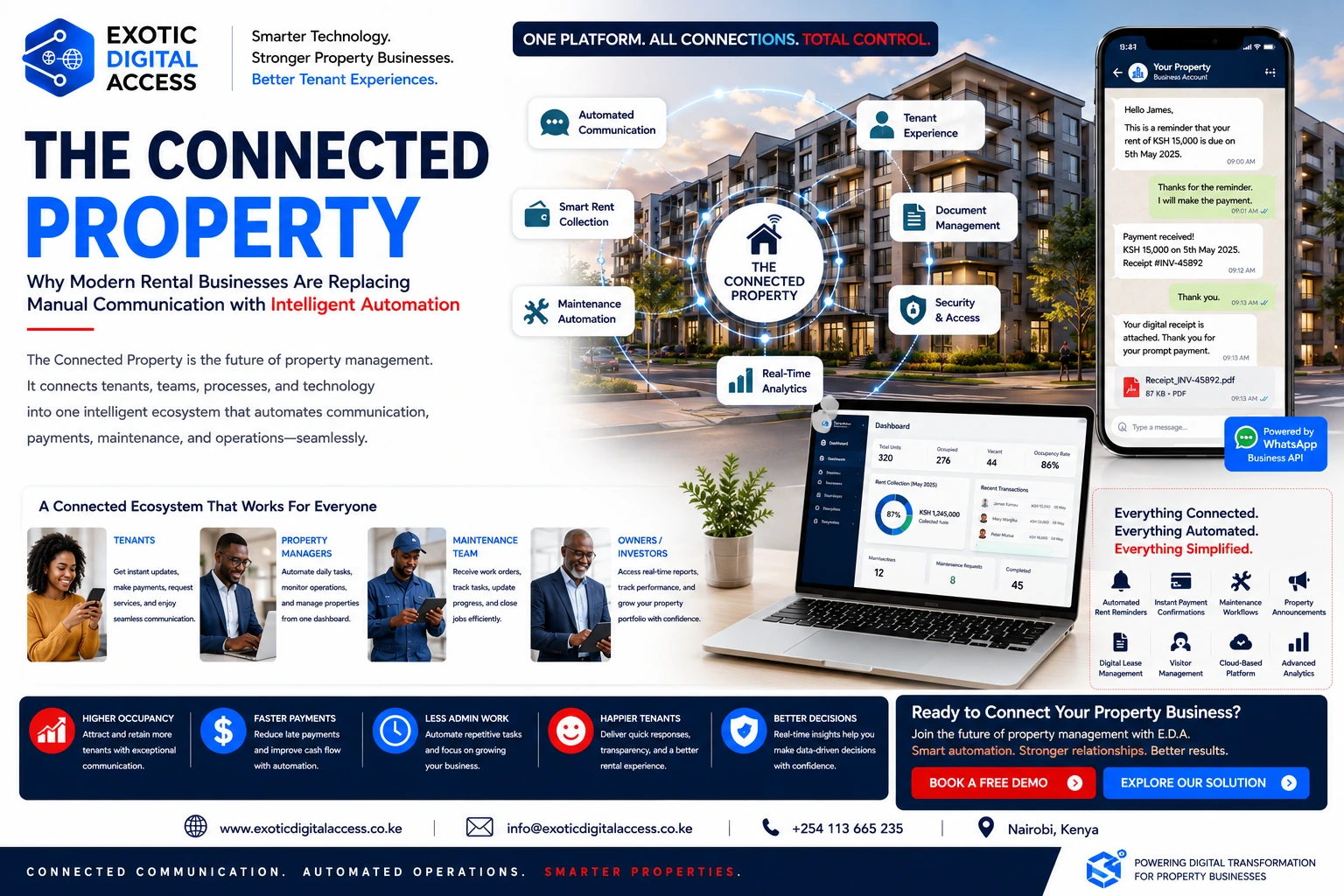
The Connected Property is what happens when a rental business stops treating communication, payments, and maintenance as three separate problems and starts treating them as one continuous flow of information — and it’s quickly becoming the standard by which Kenyan tenants judge where they choose to live.
For most of the last two decades, running a rental property in Kenya has meant running it by hand. A caretaker with a phone and a notebook. A landlord who visits units in person to collect rent. A tenant who calls three times before anyone responds to a leaking pipe. This wasn’t a failure of effort — it was simply the only infrastructure available. Buildings were managed the way small businesses have always been managed: through personal relationships, memory, and persistence.
That infrastructure is now being replaced, quietly and quickly, by something better. Across Nairobi, Mombasa, Kisumu, and the fast-growing satellite towns around them, a new generation of landlords and property managers are wiring their buildings into a single digital layer — one where a rent payment, a maintenance request, and a lease renewal all flow through the same connected system instead of three disconnected habits.
We call this shift The Connected Property, and at Exotic Digital Access (E.D.A), we believe it represents one of the more significant changes in how African real estate businesses will operate over the next five years — not because the technology is exotic, but because tenant expectations have already moved past what manual management can deliver.
What’s in this piece
The Shift Already Underway
Kenya didn’t need to be convinced to go digital first — it already had. M-Pesa turned an entire population into confident users of mobile financial services more than a decade before most Western markets caught up. WhatsApp became the default communication channel for households, businesses, and government offices alike. What Kenyan real estate has been missing isn’t appetite for technology; it’s an industry-specific layer that connects the tools people already trust into one coherent system for running a building.
The Connected Property is that layer arriving. It isn’t a single app or a single feature — it’s the recognition that a tenant paying rent, requesting a repair, and renewing a lease are all part of the same relationship, and that relationship deserves one continuous record rather than three unrelated interactions scattered across a phone, a notebook, and a filing cabinet.
Kenya National Bureau of Statistics (KNBS)
KNBS data on urban population growth underscores why rental demand — and the operational strain of managing it manually — continues to intensify across Kenya’s major towns.
knbs.or.ke →The Cost of a Disconnected Property
It’s worth being precise about what “disconnected” actually costs a rental business, because the price is rarely obvious in the moment. It shows up as a week of delayed rent because a reminder was never sent. It shows up as a tenant who doesn’t renew because a maintenance request sat unanswered. It shows up as an owner who can’t tell, without driving to the building, whether this month’s collection is on track.
Communication Depends on Memory
A caretaker’s ability to remember every tenant, every request, every promise made.
Cash Flow Is a Guess
Owners find out about arrears weeks after they start, not the day they begin.
Tenants Quietly Leave
Renewal decisions are made based on how a building felt to live in, not just the rent.
No landlord loses a tenant over a single late response. They lose them over a pattern of small frictions that a connected system would have caught the first time.
— E.D.A Property Advisory Team
What “Connected” Actually Means
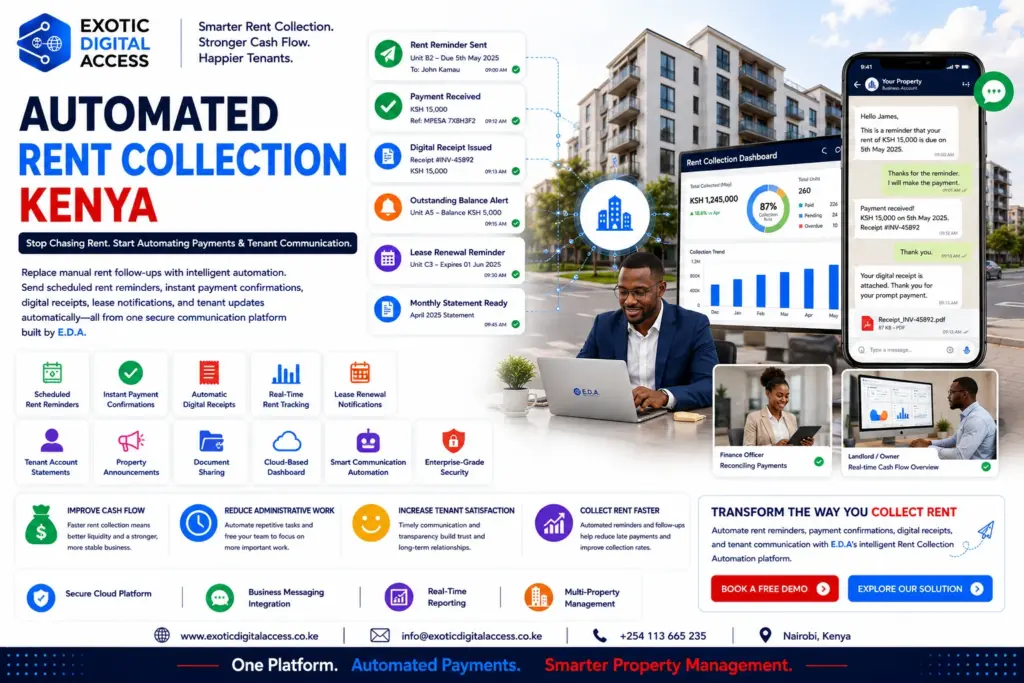
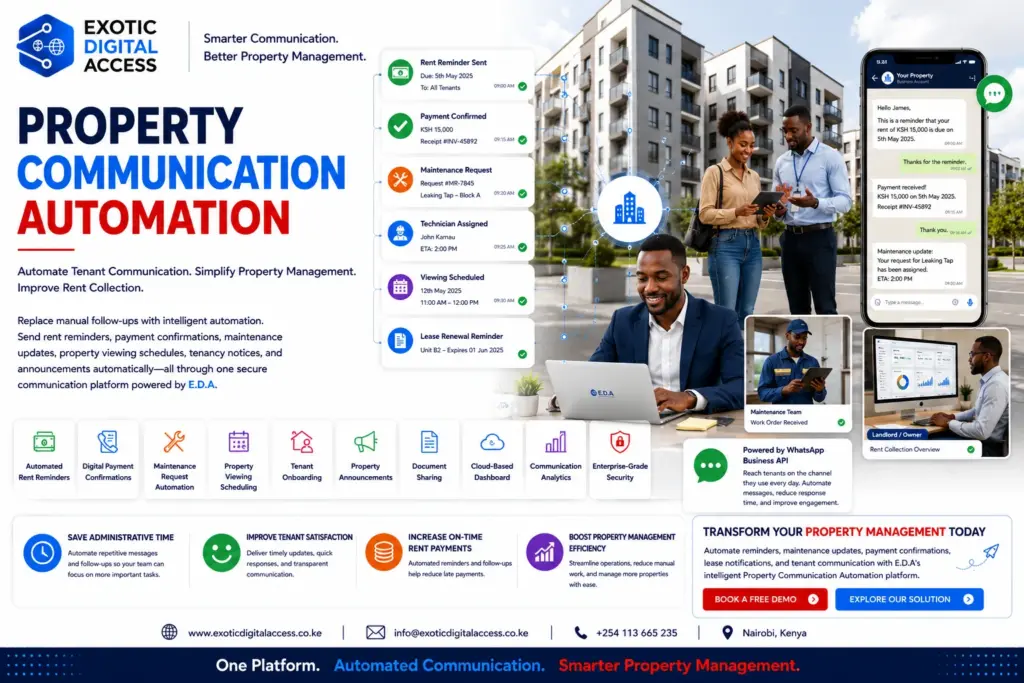
The Connected Property isn’t a marketing phrase for a rent collection app. It describes a specific architectural choice: every interaction a tenant has with a building — paying rent, reporting a fault, renewing a lease, receiving a notice — is captured in one place, and that record informs every other interaction that follows. A payment updates a ledger automatically. A maintenance request updates a technician’s queue automatically. A renewal date triggers a reminder automatically. Nothing has to be remembered twice.
Three habits become one system
In the old model, rent collection, tenant communication, and maintenance tracking were three separate habits, often carried out by three different people using three different tools — a receipt book, a phone, a clipboard. The Connected Property merges them into a single operational layer, so information captured in one place is automatically usable everywhere else.
See what a connected communication layer looks like in practice.
Explore MSG PlatformThe Old Model vs. The Connected Model
The clearest way to see the shift is side by side. The old model isn’t wrong so much as it is unsustainable past a certain scale — a single caretaker can manage a handful of units on memory and goodwill, but that approach breaks down the moment a portfolio grows beyond one building.
| Dimension | Manual Property | The Connected Property |
|---|---|---|
| Rent Reminders | Caretaker phone calls | Scheduled, automatic |
| Payment Confirmation | Handwritten receipt | Instant digital receipt |
| Maintenance Requests | Verbal report, easily lost | Logged, tracked, resolved |
| Owner Visibility | Requires a site visit | Live dashboard, anywhere |
| Tenant Communication | Ad hoc, inconsistent | Automated, consistent |
What This Means for Landlords
For landlords, The Connected Property isn’t primarily about convenience — it’s about scale. A caretaker managing eight units by memory cannot manage forty units the same way, no matter how capable they are. Owners who wire their buildings into one connected system remove the ceiling that manual management quietly imposes on portfolio growth.
Portfolios Scale Cleanly
Adding a building doesn’t multiply administrative chaos.
Cash Flow Becomes Predictable
Owners see collection status in real time, not weeks later.
Staff Time Shifts to Value
Less time chasing rent, more time solving real problems.
Disputes Nearly Disappear
A digital record settles disagreements that used to take days.
Safaricom Daraja API
Safaricom’s Daraja developer documentation illustrates the payment infrastructure Kenyan landlords are increasingly building their rent collection around.
developer.safaricom.co.ke →What This Means for Tenants
Tenants rarely describe what they want in technical terms, but the underlying expectation is consistent: they want to know that someone is aware of their situation without having to fight for attention. A connected property delivers exactly that — a rent reminder before the due date, a receipt the moment payment lands, a status update the day a maintenance request is filed. None of this requires a tenant to be tech-savvy; it simply requires the building to be connected.
🏢 Urban Apartments
High-turnover buildings where consistent communication drives renewal rates.
🎓 Student Housing
Semester cycles where automated billing removes seasonal administrative strain.
🏬 Commercial Tenancies
Longer leases where transparent records prevent costly disputes.
The Risk of Standing Still
The Connected Property is not evenly distributed yet, and that gap is itself a competitive signal. In any given neighbourhood, some buildings already operate this way, and others still run on a caretaker’s notebook. Tenants comparing two similar units increasingly notice the difference — not because one landlord is more caring than the other, but because one building responds instantly and the other doesn’t.
Expectations Have Already Moved
Landlords aren’t being asked to adopt automation ahead of demand. Tenant expectations have already shifted; the question is only how quickly a given property catches up.
Office of the Data Protection Commissioner (ODPC) Kenya
As more tenant data moves into digital systems, the ODPC’s compliance guidance is a useful reference point for landlords formalizing how they store and use tenant records.
odpc.go.ke →The Road Ahead
Over the next few years, we expect The Connected Property to move from differentiator to baseline expectation, in roughly the same way M-Pesa moved from novelty to default. The buildings that adopt this model early won’t necessarily charge higher rent for it — but they will fill vacancies faster, retain tenants longer, and spend meaningfully less on administrative overhead than buildings still run by hand.
McKinsey on Real Estate Digitization
McKinsey’s research on proptech adoption across emerging markets supports this trajectory, showing connected operating models consistently outperforming fragmented, manual ones.
mckinsey.com →Building the Infrastructure Behind the Shift
We don’t think of ourselves as a software vendor selling a rent collection app. We think of E.D.A as one of the teams building the infrastructure behind The Connected Property in Kenya — the layer that lets payments, communication, and maintenance move as one system instead of three habits. That work spans our Rental Management System, our WhatsApp-based messaging platform, POS systems, ERP solutions, and the cloud and security foundations underneath all of it.
Not a feature list. A different way of running a building.
The Connected Property is less about any single tool and more about a commitment to treat every tenant touchpoint as part of one continuous, intelligent record.
Talk to Our TeamFrequently Asked Questions
What do you mean by “The Connected Property”?
The Connected Property describes a rental business where communication, rent payments, and maintenance requests all flow through one intelligent system, rather than being handled separately through phone calls, notebooks, and disconnected tools.
Is this just another term for property management software?
Not quite. It describes an architectural shift — treating every tenant interaction as part of one continuous record — rather than any single feature or app.
Why is this happening now in Kenya specifically?
Kenya already has high trust in mobile money and WhatsApp as everyday tools. The Connected Property is the missing property-specific layer that connects those existing habits into one coherent system.
Does this only benefit large property portfolios?
No. Even a single building benefits from consistent communication and automatic payment records, though the operational relief becomes most visible as a portfolio scales.
How does E.D.A fit into this shift?
E.D.A builds the underlying systems — rental management, WhatsApp messaging, payments, and reporting — that let a property operate as one connected layer rather than three disconnected habits.
What happens to landlords who don’t make this shift?
They aren’t penalized directly, but they increasingly compete against buildings that respond faster and communicate more consistently — a gap tenants notice when comparing similar units.
Is tenant data handled responsibly in a connected model?
Yes. Payment and communication records are encrypted and access-controlled, in line with Kenya’s Data Protection Act requirements.
A New Standard, Not a New Feature
The Connected Property isn’t a trend to watch from a distance — it’s already reshaping which buildings fill quickly, which tenants renew, and which landlords spend their evenings on strategy instead of collections. The shift from three disconnected habits to one intelligent system is less about adopting new software and more about recognizing that tenants now expect their building to know what’s happening in their tenancy without being told twice.
The landlords moving fastest on this aren’t necessarily the largest ones — they’re the ones who recognized early that manual communication was never going to scale, and that a connected property is simply a better way to run a rental business, at any size.
At Exotic Digital Access, we’re building the infrastructure for that shift in Kenya, and we’d welcome the chance to show you what a connected property looks like for your buildings.
More from the E.D.A Blog
Explore more perspectives on property management, automation, and business technology for Kenyan landlords on the E.D.A blog.
exoticdigitalaccess.co.ke/e.d.a.blog →See What a Connected Property Looks Like
Book a conversation with E.D.A and see how communication, payments, and maintenance can move through one intelligent system for your buildings.