Bar POS Training — The Complete Guide for Kenya’s Bars, Clubs & Hospitality Venues
Effective Bar POS Training is the difference between a team that maximises every transaction and one that accidentally loses revenue every shift. This complete guide covers every aspect of Bar POS Training — from bartender onboarding to manager analytics — ensuring your team is proficient, confident, and compliant from day one.
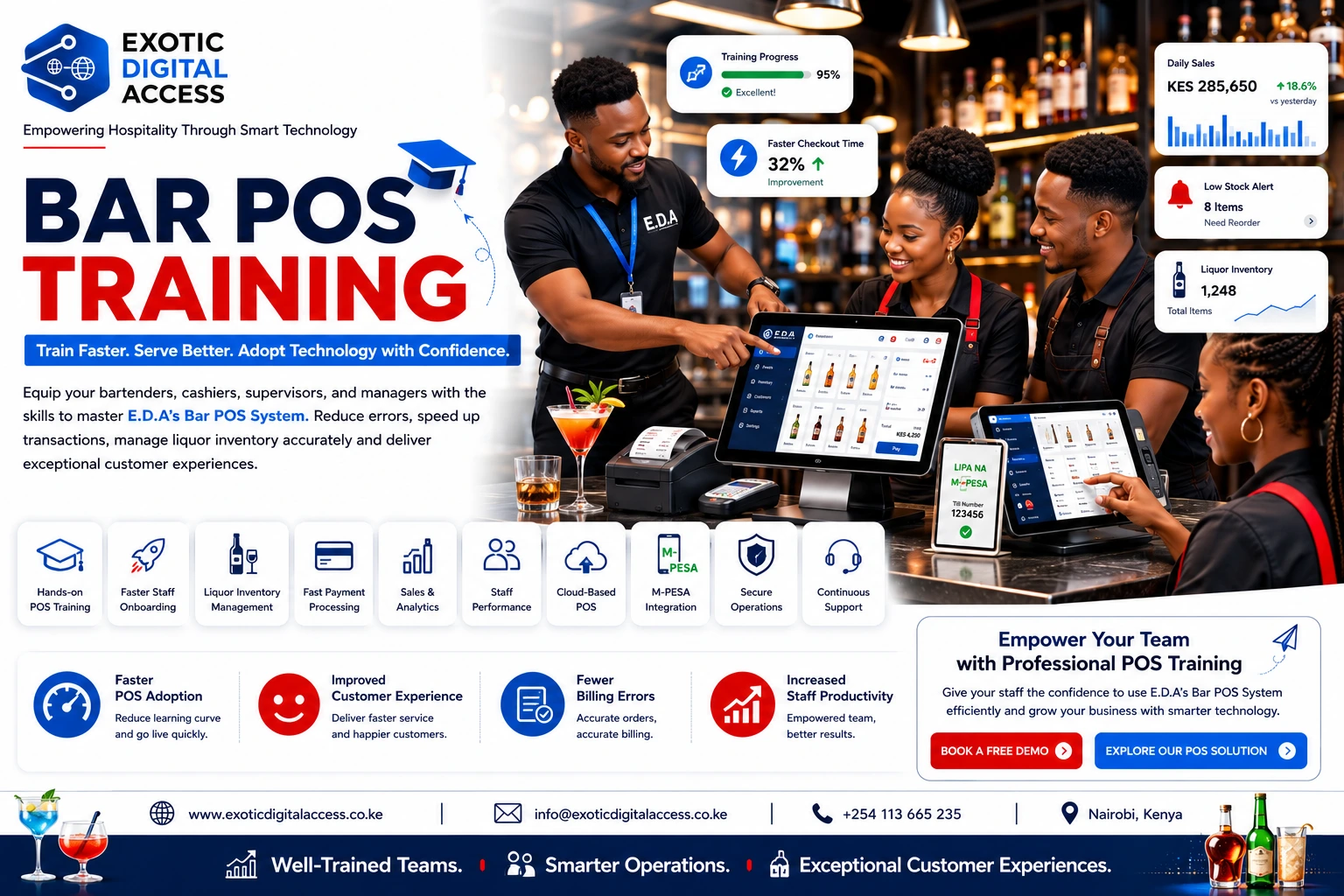
A Bar POS System is only as effective as the people using it. A venue that invests in the best point-of-sale platform in Kenya but skips structured Bar POS Training for its staff will still lose revenue — from incorrectly processed tabs, M-Pesa errors, missed promotions, voided transactions handled outside proper protocol, and end-of-shift reconciliation that never balances. Bar POS Training is the investment that ensures every shilling the system is designed to capture actually reaches the bank.
The E.D.A Bar POS System Kenya is designed to be intuitive and fast to learn — but every bar environment is different, every team has a different starting point, and every role within the venue interacts with the system in a different way. Structured Bar POS Training aligned to each role — bartenders, cashiers, floor staff, supervisors, and venue managers — ensures every team member develops the specific skills and system knowledge they need to perform their role effectively from the first shift they use the system.
Proper Bar POS Training also protects the venue from the compliance risks that arise from staff who do not understand how the system generates KRA eTIMS invoices, how M-Pesa STK Push payments must be handled, or how void transactions must be authorised. In Kenya’s 2026 eTIMS enforcement environment, every transaction your bar processes must result in a compliant electronic tax invoice — and that requires staff who understand not just how to take orders but how to complete transactions correctly in the system.
What this guide covers
- Why Bar POS Training matters for your venue’s revenue
- The E.D.A Bar POS Training module structure
- Role-specific training — bartenders, cashiers, managers
- Cashier training — fast billing and M-Pesa processing
- Tab management training — capturing every order
- Stock control training — ending shrinkage
- Manager training — analytics, reports and controls
- eTIMS compliance training — KRA requirements
- WhatsApp integration training — customer engagement
- Common Bar POS Training mistakes to avoid
- Bar POS Training best practices
- Ongoing training and system updates
- Frequently asked questions
Why Bar POS Training Directly Impacts Your Venue’s Revenue
Many bar owners view Bar POS Training as a one-time setup activity — something to rush through during system installation so staff can start using the system as quickly as possible. This approach consistently produces the same outcomes: staff who can complete basic transactions but make regular errors, managers who cannot generate the reports they need because they were never shown how, and a compliance posture that is fragile because no one on the team fully understands the eTIMS and M-Pesa workflows that the system handles automatically when used correctly.
“A bar that invests KSh 50,000 in a POS system and KSh 0 in Bar POS Training is not running a digital bar. It is running a manual bar with an expensive machine that no one uses to its full capability.”
— E.D.A Hospitality Training Report, Kenya 2026The business cost of inadequate Bar POS Training shows up in multiple ways — some immediately visible, others accumulating silently over weeks and months:
- Tabs closed before all orders are added
- M-Pesa payments processed incorrectly
- Voids and refunds handled outside protocol
- Promotions applied at wrong times or rates
- Stock records incorrect due to wrong product selection
- End-of-shift reconciliation errors every night
- eTIMS compliance gaps creating KRA exposure
- WhatsApp receipts not sent due to process errors
- Manager reports not understood or used
- New staff taking weeks to reach competency
- High-pressure nights handled poorly at the system level
- Cover charges not recorded through the right channel
Each of these problems has a direct monetary cost — in revenue not collected, in penalties for compliance failures, in the management time spent investigating and resolving discrepancies that proper Bar POS Training would have prevented entirely. Investing in comprehensive, role-specific Bar POS Training from day one is not an optional onboarding nicety — it is the single most important step a venue can take to ensure that the investment in a Bar POS System actually delivers its full return.
Ready to train your team on the E.D.A Bar POS System? Book structured Bar POS Training for your venue — role-based, practical, and designed for go-live in 24 hours.
Book Bar POS TrainingThe E.D.A Bar POS Training Module Structure
The E.D.A Bar POS Training programme is structured around the actual workflows that bar and club staff encounter every shift — not generic software tutorials that disconnect from the reality of a busy hospitality environment. Every Bar POS Training module is designed to be practical, fast to absorb, and immediately applicable during live service — building staff competency in the shortest possible time without cutting corners on the skills that protect revenue and ensure compliance.
System Orientation — Understanding the E.D.A Platform
The first Bar POS Training module introduces staff to the E.D.A Bar POS System interface — the menu structure, navigation logic, user login and logout process, and the overall workflow that connects orders to payments to receipts. Staff leave this module confident in finding what they need and understanding how the different parts of the system relate to their role.
⏱ 30–45 minutes · All rolesOrder Processing — From Drink Request to Recorded Sale
This Bar POS Training module covers the complete order entry workflow — searching the menu, selecting products, applying quantities, managing modifiers (ice, mixers, sizes), adding orders to the correct tab, and confirming the transaction. Bartenders and cashiers practice the full order entry flow until it becomes fast and instinctive.
⏱ 45–60 minutes · Bartenders, CashiersTab Management — Opening, Managing, and Closing Tabs
The tab management Bar POS Training module covers opening a tab correctly (table number, customer name, section assignment), adding orders throughout the evening, handling tab transfers between tables or staff, applying mid-tab discounts, and closing tabs accurately at payment — including split bill processing and multi-payment settlement.
⏱ 60 minutes · Bartenders, Cashiers, Floor StaffM-Pesa Payment Processing — STK Push and Reconciliation
The M-Pesa Bar POS Training module teaches staff the complete M-Pesa STK Push payment workflow — initiating the payment request from the system, confirming payment receipt, handling failed or declined payments, processing partial M-Pesa payments alongside cash, and understanding how M-Pesa reconciliation works at shift end.
⏱ 45 minutes · Cashiers, SupervisorseTIMS Compliance — Understanding the Automatic Invoice Workflow
The eTIMS Bar POS Training module ensures all staff understand how the E.D.A system generates and transmits KRA-compliant electronic tax invoices automatically with every transaction. Staff learn to recognise a compliant receipt, understand what to do if a transaction does not generate an eTIMS record, and know the escalation path for any compliance concern.
⏱ 30 minutes · All rolesPromotions, Happy Hours, and Discounts
This Bar POS Training module covers how promotions are configured in the system, how time-based happy hour pricing activates and deactivates automatically, how staff can apply manual discounts within their authorisation level, and how to handle customer requests for discounts that exceed their permission threshold.
⏱ 30 minutes · Bartenders, CashiersVoid, Refund, and Correction Handling
The void and refund Bar POS Training module covers how to handle ordering mistakes — the correct process for voiding an item before payment, the refund workflow after payment, the manager authorisation requirement, and the importance of following void protocol rather than working around it in ways that create untracked discrepancies.
⏱ 30 minutes · Cashiers, SupervisorsShift Cash-Up and End-of-Day Reconciliation
This Bar POS Training module prepares supervisors and cashiers for accurate end-of-shift cash-up — counting the float, generating the cashier-level shift report, reconciling M-Pesa totals with the system, identifying and reporting discrepancies, and completing the shift close process correctly so the next shift starts with accurate opening balances.
⏱ 45 minutes · Cashiers, SupervisorsManager Analytics — Reports, Inventory, and Business Intelligence
The manager Bar POS Training module covers every aspect of the management dashboard — generating nightly sales reports, reviewing staff performance data, accessing inventory variance reports, monitoring VIP section revenue, analysing peak hour patterns, and using business intelligence to make operational and strategic decisions. Managers leave this module knowing how to extract maximum value from the system’s analytics capability.
⏱ 90 minutes · Managers, OwnersAccess the E.D.A Bar POS System portal
Practice and reference the E.D.A Bar POS System through the dedicated portal — accessible from any device for training sessions and live operation. Access the E.D.A POS portal →
Bar POS Training by Role — Everyone Trained for Their Specific Responsibilities
Effective Bar POS Training is not a single generic session that everyone attends together. Different roles in the bar interact with the system in fundamentally different ways — a bartender’s primary system interaction is order entry and tab management, while a venue manager needs deep analytics capability and full system configuration access. The E.D.A Bar POS Training programme is structured around four distinct role tracks, each focused on the specific system knowledge and practical skills that role requires.
Bartender Training
Bartenders are the highest-volume system users — processing dozens of orders per shift at speed. Bar POS Training for bartenders focuses on fast order entry, tab management, and product knowledge navigation.
Cashier Training
Cashiers handle all payment processing and tab settlement. Bar POS Training for cashiers covers complete payment workflows, M-Pesa STK Push, shift cash management, and reconciliation.
Supervisor Training
Supervisors manage the team and handle escalated situations. Bar POS Training for supervisors includes void authorisation, discount approval, inter-shift handover, and team performance monitoring.
Manager / Owner Training
Managers and owners use the system for analytics, configuration, and strategic decisions. Bar POS Training at this level covers the full management dashboard, inventory control, and business intelligence.
Cashier Bar POS Training — Processing Payments Correctly Every Time
The cashier role is where the most direct revenue exposure exists in any bar operation. A cashier who is inadequately trained in the Bar POS Training programme will make payment processing errors that result in either under-collection (the venue loses revenue) or over-collection (customers dispute charges) — both of which create operational and reputational problems that proper training prevents entirely.
M-Pesa STK Push Mastery
Bar POS Training for cashiers covers the complete M-Pesa STK Push workflow — initiating the payment prompt from the correct screen, confirming the customer’s phone number, waiting for and verifying confirmation, and understanding what to do when a push fails, times out, or the customer receives duplicate prompts.
Cash Float Management
Proper Bar POS Training teaches cashiers how to open a shift with the correct float, record cash transactions accurately, manage change calculations, secure cash during service, and complete end-of-shift float reconciliation that matches the system’s expected cash total.
Multi-Payment Processing
Many bar transactions involve split payments — part M-Pesa, part cash, or multiple customers sharing a tab. Bar POS Training covers each multi-payment scenario so cashiers handle split settlements accurately without creating reconciliation problems.
Cover Charge Processing
Bar POS Training specifically addresses cover charge collection — one of the most frequently mismanaged revenue streams in Kenyan clubs. Cashiers learn to process every entry fee through the system rather than handling it informally outside the POS workflow.
eTIMS Receipt Verification
Bar POS Training ensures every cashier understands that a valid transaction generates a KRA QR-coded eTIMS receipt automatically. They know how to identify when a receipt is missing the compliance elements and the escalation process for any eTIMS-related transaction issue.
Shift End Cash-Up Procedure
Bar POS Training’s cash-up module teaches cashiers to generate their individual shift report, count and record their float, reconcile the M-Pesa total, identify discrepancies before they escalate, and complete the shift close process that sets the next cashier up for a clean start.
Tab Management Bar POS Training — Capturing Every Order on Every Busy Night
Tab management is the single area where most bar revenue leakage originates — and it is the area where Bar POS Training delivers its most immediate and most measurable return on investment. Every tab that is not closed correctly, every order added to the wrong tab, and every drink served that never makes it onto a tab at all represents revenue that the venue served but never collected. Comprehensive tab management Bar POS Training closes these gaps permanently.
Opening Tabs Correctly
Bar POS Training teaches staff to open every tab with the correct table number, section assignment, and customer name — creating a clear, unambiguous record that every staff member serving that table can access and add to without confusion or duplication.
Adding Orders to the Right Tab
High-volume service creates the risk of adding drinks to the wrong tab — a problem that results in customers being charged for drinks they did not order and other tabs being understated. Bar POS Training drills the tab selection habit until it is automatic even under pressure.
VIP and Bottle Service Tabs
VIP sections with minimum spend requirements and pre-purchased bottle service need specialised Bar POS Training to handle correctly — ensuring bottle service is tracked, minimum spend is monitored in real time, and additional orders are added to the VIP tab accurately throughout the evening.
Tab Transfers and Splits
When customers move between tables, merge groups, or split a large tab between friends, Bar POS Training covers the correct system workflow for each scenario — preventing the common errors that result from staff trying to handle these situations manually outside the system.
Tab Closing Accuracy
Bar POS Training’s tab closing module ensures staff review the tab total for completeness before closing, confirm the correct payment method, and always generate the customer receipt — eliminating the partial-tab closures and missed items that are the primary source of tab-related revenue loss.
End-of-Night Tab Audit
Bar POS Training teaches supervisors how to run an open-tab audit at service end — identifying any tabs that were not closed, investigating uncollected balances, and ensuring the night’s revenue is fully collected before the venue closes.
Stock Control Bar POS Training — Accountability from Bar to Books
The inventory and stock control component of Bar POS Training is critical for ending the silent revenue drain that stock shrinkage creates. When bar staff understand how every drink they serve connects to a stock record in the system, the accountability culture that prevents pilferage and measurement generosity takes root — because staff know that every unrecorded pour creates a variance that the system will detect and report.
Product-to-Stock Linkage
Bar POS Training explains to every staff member how selecting a product in the system deducts stock — making the invisible connection between the order screen and the inventory record visible and understandable, which changes how staff think about unrecorded drinks.
Receiving Stock into the System
Bar POS Training for supervisors and store managers covers the correct procedure for receiving supplier deliveries — confirming quantities in the system, recording batch details, and ensuring new stock is logged before it is moved to the bar counter.
Reading Variance Reports
Manager Bar POS Training covers how to read and interpret stock variance reports — understanding the difference between theoretical and physical stock, identifying which products are showing the largest variances, and determining whether variance is due to recording errors, measurement issues, or pilferage.
Low-Stock Alerts and Reordering
Bar POS Training teaches supervisors how low-stock alerts are configured and triggered, how to respond to an alert appropriately (reorder, transfer from store, or notify management), and how to initiate a purchase order within the system when stock needs replenishing.
Manager Bar POS Training — Unlocking the Full Power of Analytics
The most significant gap in most bars’ POS capability is not at the order entry or payment processing level — it is at the management level. Many bar managers and owners know how to use their system for transactions but have never been trained on the analytics and reporting capabilities that represent the system’s most powerful business value. Proper manager-level Bar POS Training changes this completely — giving venue owners the data-driven management capability that consistently delivers the best results in the most successful bars across Kenya.
Revenue Dashboard Mastery
Bar POS Training for managers covers the full revenue dashboard — understanding which metrics matter most, how to interpret daily versus weekly versus monthly performance, and how to identify trends that require immediate management action versus patterns that represent longer-term shifts.
Staff Performance Analysis
Manager Bar POS Training covers how to access individual cashier and bartender performance reports — understanding which metrics indicate high performance, which patterns suggest accountability issues, and how to use system data in staff performance conversations.
Menu and Drink Performance
Bar POS Training teaches managers to analyse which drinks deliver the best combination of volume, revenue, and margin — enabling data-driven decisions about menu adjustments, pricing strategy, and promotional investment that improve profitability over time.
System Configuration
Manager Bar POS Training covers the system configuration capabilities available at management level — adding new products, adjusting prices, configuring promotions, setting low-stock thresholds, creating user accounts, and adjusting permission levels for different staff roles.
End-of-Month Reporting
Bar POS Training ensures managers can generate and interpret end-of-month consolidated reports — P&L summaries, inventory valuation, supplier spending, customer analysis, and the tax-ready eTIMS data that KRA filing requires — without needing manual data compilation from multiple sources.
Multi-Branch Monitoring
For venue owners operating multiple bars or clubs, Bar POS Training covers the multi-branch dashboard — comparing performance across locations, monitoring inter-branch stock transfers, and identifying which venues need management attention versus which are performing to target.
E.D.A Blog — bar management guides and resources
Find detailed bar management guides, POS training tips, and the latest E.D.A hospitality platform updates on the E.D.A blog. Visit the E.D.A Blog →
eTIMS Compliance Bar POS Training — Every Transaction, Every Time
KRA’s eTIMS enforcement since January 2026 makes compliance training a mandatory component of any Bar POS Training programme for Kenyan venues. Every bar and club transaction must generate a KRA-compliant electronic tax invoice transmitted to KRA’s eTIMS system — and while the E.D.A Bar POS System handles this automatically, staff must understand the compliance workflow well enough to recognise when something has gone wrong and to follow the correct escalation procedure.
What every staff member must know about eTIMS in Bar POS Training
The E.D.A Bar POS System generates and transmits a KRA-compliant eTIMS invoice automatically with every completed transaction. The customer’s receipt carries a KRA QR code and control unit number that verifies compliance. Bar POS Training ensures every team member — from bartenders to managers — understands that the eTIMS compliance is automatic, how to recognise a compliant receipt, and what to do if a transaction completes without generating the correct eTIMS record.
KRA eTIMS Resources →The eTIMS component of Bar POS Training covers three essential areas for all staff:
- What eTIMS is and why it is mandatory in 2026
- How the automatic invoice generation works in the system
- How to identify a compliant receipt (QR code + control number)
- What to do if a receipt is missing compliance elements
- The penalties for non-compliance and who bears them
- How to escalate a potential eTIMS failure to management
WhatsApp Integration Bar POS Training — Turning Transactions into Relationships
The E.D.A Bar POS System integrates with the E.D.A MSG WhatsApp platform to automate customer receipts, event marketing, and engagement campaigns. The WhatsApp component of Bar POS Training ensures that staff and managers understand how this integration works, how to ensure customers receive their WhatsApp receipts correctly, and how management can use the MSG platform to build and run customer engagement campaigns that drive repeat visits.
WhatsApp Receipt Workflow
Bar POS Training covers how WhatsApp receipts are triggered automatically at payment — what information appears on the receipt, how to confirm a customer’s WhatsApp number is recorded correctly in the system, and what to do when a customer reports not receiving their digital receipt.
Event Marketing with E.D.A MSG
Manager Bar POS Training covers how to use the E.D.A MSG platform to create and send event announcements, promotions, and special offers to the venue’s WhatsApp customer database — segmenting by visit frequency, spend level, or drink preference for targeted campaigns.
AI Chatbot Configuration
Advanced manager Bar POS Training covers the E.D.A MSG AI chatbot — how to configure responses for common customer queries (opening hours, events, booking, dress code), and how to monitor chatbot performance to ensure customer enquiries are being answered accurately.
The E.D.A MSG platform works alongside the Bar POS System for automated WhatsApp customer engagement. Ask about MSG training as part of your Bar POS Training programme.
Explore E.D.A MSG →Common Bar POS Training Mistakes Kenyan Venues Make
Understanding what goes wrong in poorly structured Bar POS Training programmes helps venue owners and managers design a training approach that avoids the most costly pitfalls — and ensures that the investment in a Bar POS System delivers its full operational and financial return from the first week of live service.
Rushing Through Training During Installation
Compressing Bar POS Training into a single hurried session on installation day — while staff are distracted by setup activity and eager to start — produces superficial knowledge that breaks down the moment a non-standard situation arises during service. Allow proper time for each training module.
Training Everyone Together Regardless of Role
Delivering the same Bar POS Training to bartenders and managers simultaneously means neither group gets the depth they need. Bartenders waste time on management analytics they will not use, while managers do not get enough time on the operational workflows they need to supervise effectively.
Skipping the eTIMS Compliance Module
Many Bar POS Training programmes focus entirely on transaction processing and skip eTIMS compliance education. This creates a team that can take orders and process payments but does not understand the compliance context — leaving the venue exposed when a compliance question arises during service.
Not Training on Voids and Refunds
Bar POS Training that glosses over void and refund procedures produces staff who handle ordering mistakes informally — deleting charges without system records, giving free drinks outside the comps process, or creating negative transactions that are outside their authorisation level.
Never Training Managers on Analytics
A surprisingly common Bar POS Training failure is focusing entirely on operational training and leaving managers without the analytics skills to use the system’s reporting capability. Without this training, the most powerful feature of the Bar POS System — business intelligence — goes completely unused.
No Refresher Training for New Staff
Bar environments have high staff turnover. A venue that delivers thorough Bar POS Training at launch but has no structured onboarding programme for new hires will see training quality degrade over time as newer staff pick up habits from colleagues rather than from the correct system workflow.
Bar POS Training Best Practices — Getting Your Team Ready Fast
The most effective Bar POS Training programmes share a set of structural and pedagogical principles that maximise knowledge retention, minimise the time to competency, and ensure that the skills developed in training translate directly into improved performance during live service. Here are the best practices the E.D.A training team applies in every venue implementation:
Practical Over Theoretical
The best Bar POS Training is done on the actual system, processing actual (practice) transactions, not watching slideshows. Hands-on practice in a training environment — where mistakes do not matter — builds the muscle memory that transfers to live service.
Role-Specific Depth
Each role in Bar POS Training should receive the depth of training their specific responsibilities require — not a generic overview that leaves everyone partially informed and no one fully competent in what they actually need to do.
Scenario-Based Practice
Bar POS Training should cover the scenarios staff will actually encounter during service — a customer changing their order mid-tab, a M-Pesa payment that fails at confirmation, a split bill between five people, a happy hour promotion that needs applying manually. Practice on real scenarios builds real competency.
Structured Reference Materials
Every member of staff who completes Bar POS Training should leave with a role-specific quick reference guide — a single-page summary of the most important workflows and procedures they can consult during service until the skills become automatic.
Supervised Live Trial Shifts
The best Bar POS Training concludes with supervised trial shifts — where trained staff process real transactions in a live service environment with an experienced supervisor or E.D.A trainer available to guide them through edge cases and build confidence in the live environment.
Competency Verification Before Solo Operation
Bar POS Training should include a competency checkpoint — a structured assessment of each staff member’s ability to complete key workflows correctly before they are permitted to operate the system independently during service without supervision available.
New Staff Onboarding Protocol
Every venue should have a documented Bar POS Training onboarding protocol for new hires — covering the same training modules as the original programme, delivered by a trained internal champion or an E.D.A trainer, before the new employee’s first independent shift.
Regular Refresher Training
Bar POS Training should not be a one-time event. Regular refresher sessions — monthly for new staff, quarterly for experienced team members — ensure that the correct system habits are maintained over time and that teams are updated on any system changes or new feature capabilities.
Ongoing Bar POS Training — Keeping Your Team Current as the System Evolves
The E.D.A Bar POS System is a living platform — updated regularly with new features, capability improvements, and enhancements that make bar management easier and more effective. Ongoing Bar POS Training ensures your team is always taking advantage of the latest capabilities rather than operating the system at the level they first learned it, missing the improvements that could further enhance the venue’s operational performance.
The E.D.A team provides ongoing training support for all platform clients — including new feature training when significant updates are released, refresher training resources available through the E.D.A Blog, and direct support from the Kenya-based training team when specific Bar POS Training needs arise at your venue.
System Update Training
When the E.D.A Bar POS System releases significant updates, our team provides Bar POS Training resources covering new features — so your team can adopt improvements quickly and confidently without learning through trial and error during live service.
New Staff Onboarding
The E.D.A team supports structured Bar POS Training for new hires — either through on-site training sessions at the venue, remote training via video call, or self-guided training materials developed for each role within your specific venue configuration.
Live Training Support
Our Kenya-based support team is available to guide staff through unfamiliar workflows in real time — providing Bar POS Training at the moment it is needed during live service, not just during scheduled sessions before launch.
Training Resource Library
E.D.A maintains a growing library of Bar POS Training guides, video walkthroughs, and quick reference materials available to all platform clients — accessible through the support portal and regularly updated as the platform evolves.
Already using E.D.A but want to improve your team’s system proficiency? Contact the E.D.A team to arrange a targeted Bar POS Training refresher session.
Arrange Refresher TrainingFrequently Asked Questions About Bar POS Training
What is Bar POS Training and why does my venue need it?
How long does Bar POS Training take for a typical bar team?
Does E.D.A provide on-site Bar POS Training in Kenya?
Is eTIMS compliance covered in the E.D.A Bar POS Training?
How does Bar POS Training handle M-Pesa payment processing?
What ongoing Bar POS Training support does E.D.A provide?
Bar POS Training Is the Investment That Makes Every Other Investment Work
A Bar POS System without proper Bar POS Training is an opportunity that is only partially realised. The analytics go unused, the tab management capability is not applied consistently, the M-Pesa workflow is handled informally, and the eTIMS compliance that should be automatic becomes uncertain. Every one of these gaps has a monetary cost — in revenue not collected, in compliance penalties, and in the management time spent investigating problems that training would have prevented.
Comprehensive, role-specific Bar POS Training transforms this equation entirely. Bartenders process orders faster and capture every drink on the correct tab. Cashiers handle M-Pesa payments accurately and reconcile their shifts in minutes rather than hours. Supervisors use the system’s accountability features to manage their teams more effectively. Managers use the analytics dashboard to make every venue decision on data rather than intuition. And the entire team operates within a framework of eTIMS compliance that protects the venue from the regulatory exposure that inadequate training would leave it vulnerable to.
The E.D.A Bar POS Training programme is designed to deliver all of this — quickly, practically, and in a format that translates directly into improved performance during live service. Whether you are implementing the E.D.A Bar POS System for the first time, onboarding new team members, or refreshing your existing team’s knowledge, structured Bar POS Training is the investment that makes everything else work.
More on the E.D.A Blog
Explore bar management guides, hospitality technology insights, and POS training resources on the E.D.A blog. Visit the E.D.A Blog →
Ready to Train Your Bar Team on the E.D.A Bar POS System?
Book structured Bar POS Training for your venue — role-based, practical, and designed to get your entire team operational with confidence in 24 to 48 hours. Contact the E.D.A team today.